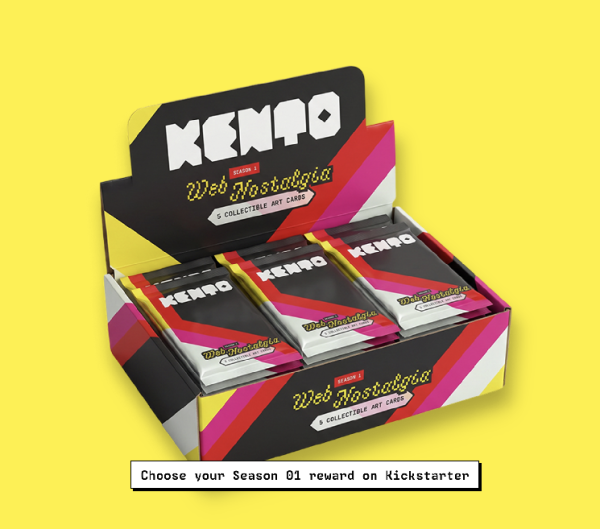


The team behind digital art marketplace objkt may have found a surprisingly simple way to get people interested in collecting digital art again: put it inside a pack of trading cards.
Kento, a new physical-digital collectible created by the objkt team, raised more than $100,000 on Kickstarter within its first 24 hours. By Thursday morning, the campaign had reached approximately $108,370 from 447 backers, equivalent to 2,000% of its original funding goal.
The concept combines the familiar experience of opening collectible card packs with ownership of digital art.
Kento’s first season turns 117 original works from 40 artists into physical trading cards. Each blind pack contains five cards spread across seven rarity levels, but every card also represents an artwork that can be owned digitally.
A QR code hidden beneath a scratch-off layer on the back allows the collector to claim the corresponding artwork onchain. Owners can also choose never to scratch the card, preserving it in its original physical form.
“Crossing $100,000 in less than 24 hours is a strong signal that people are ready for a new way to collect art,” said Brian Mc Alister, co-founder of Kento and objkt. “Kento was built to make great art accessible and collectible, and this is only the beginning.”
Can Trading Cards Make Digital Art Easier to Collect?
Kento arrives after a dramatic boom-and-bust cycle for NFTs changed the digital art market. For many newcomers, collecting digital art still comes with unfamiliar concepts ranging from crypto wallets and blockchains to marketplaces and onchain transactions.
Kento starts somewhere much more familiar: opening a pack of cards.
“Digital art is the art of our time, but we realized that a lot of people connect better with art when there’s a physical aspect to it,” Mc Alister said. “That’s why we thought: why not try it in a card format?”
The idea emerged after the team spent five years building objkt, which launched in 2021 and now hosts more than seven million digital artworks.
Kento effectively reverses the usual $NFT experience. Instead of discovering an artwork online and then figuring out how to buy it onchain, collectors can discover the work physically and decide afterward whether they want to claim its digital counterpart.
That could also expose digital artists to collectors who have never purchased an $NFT.
From Pokémon Packs to Onchain Art
The first Kento collection is built around Web Nostalgia, a theme inspired by the early internet and its personal websites, chatrooms, forums, pixel graphics, glitches and primitive interfaces.
The 40-artist lineup includes Los Angeles-based artist and Forbes 30 Under 30 honoree Amber Vittoria, UK digital artist George Goodwin, better known as OMGiDRAWEDit, and Tokyo-born generative artist Kazumasa Teshigawara, known as qubibi.
For Goodwin, the trading-card format has an obvious appeal.
“If you’d seen how much money I’ve spent on Pokémon cards in my life, you would understand why joining Kento was an instant yes,” he said. “I like the rush of opening a pack and maybe getting a rare one, but I also like looking at the cards.”
His experience points to one of the mechanics Kento is borrowing directly from traditional collectibles: rarity and the uncertainty of opening a blind pack.
Kento combines that experience with digital ownership rather than asking collectors to choose between physical and digital formats.
Qubibi’s contribution takes the nostalgia theme back even further. His artwork, tables, references the days when web designers constructed entire websites using HTML tables. The generative work turns that early design technique into a constantly nested digital environment.
Artists Get a Share of Pack Sales
Kento is also experimenting with how participating artists are paid. Artists receive upfront compensation for their work as well as a share of revenue generated by pack sales, giving them continued participation if a season becomes successful.
Kickstarter proceeds will fund production of the first physical card collection and development of future releases. The campaign remains open through October 1, with rewards expected to begin shipping in December 2026.
The early numbers suggest the physical-digital combination has struck a chord. Reaching 2,000% of its funding target within roughly a day is particularly notable for a product built around digital art at a time when the $NFT market no longer commands anything close to the mainstream attention it did during its peak.
Kento isn’t trying to recreate that era. Instead, it is taking one of the central ideas behind NFTs, owning digital art, and packaging it inside something collectors already understand. For the first 447 backers, that experience begins by tearing open a pack.
